


Understanding Design and Functions of Shell & Tube Heat Exchangers
Shell & Tube heat exchangers are among the most widely used heat transfer
equipment in chemical, petrochemical, oil & gas, power generation,
pharmaceutical, and fertilizer industries.
At MECh Engineers, Valsad, Shell & Tube heat exchangers are
engineered as pressure equipment, combining thermal efficiency, mechanical
reliability, metallurgy expertise, and strict compliance with applicable
codes and statutory requirements.
What Is a Shell & Tube Heat Exchanger?
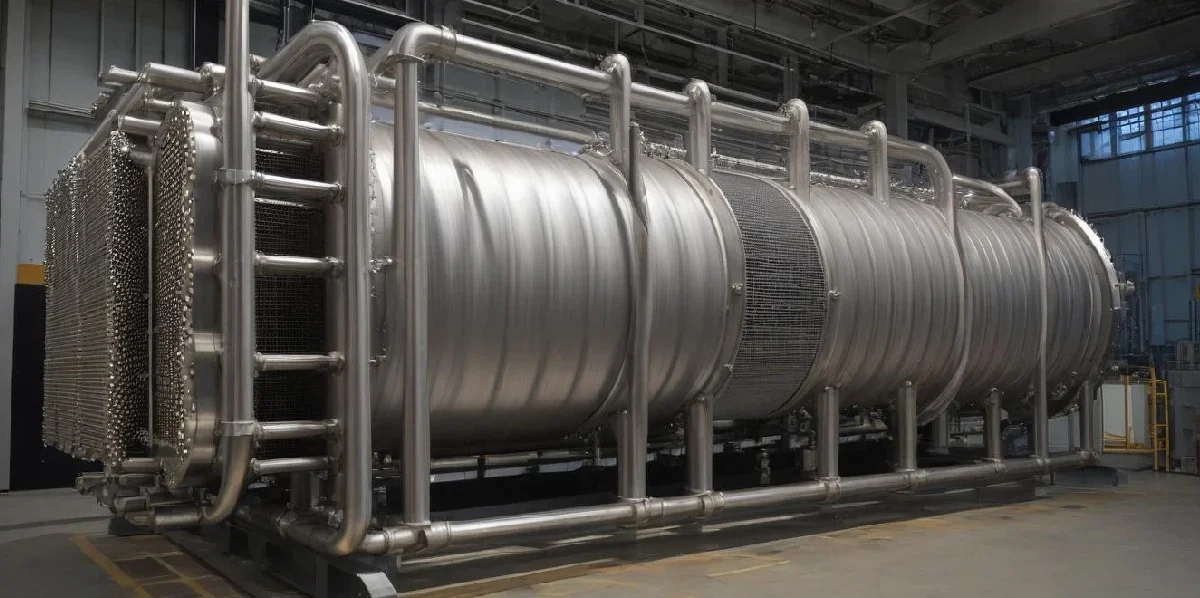
A Shell & Tube heat exchanger consists of a bundle of tubes enclosed within
a cylindrical shell. One fluid flows through the tubes while the other flows
on the shell side. Heat is transferred across the tube walls without mixing
the fluids, ensuring safe and efficient operation.
Key Components and Their Functions
Shell
The shell forms the outer pressure boundary of the heat exchanger and contains
the shell-side fluid. It provides structural strength and is designed to
withstand operating pressure and temperature.
Tube Bundle
The tube bundle carries the tube-side fluid and provides the primary heat
transfer surface. Tube size, thickness, layout, and material directly
influence heat transfer efficiency and pressure drop.
Tube Sheets
Tube sheets secure the tubes at both ends of the exchanger and ensure
leak‑tight separation between tube-side and shell-side fluids.
Channel Heads
Channel heads distribute tube-side fluid into the tubes and allow easy access
for inspection and maintenance.
Baffles
Baffles direct shell-side fluid across the tubes, increasing turbulence and
improving heat transfer. They also support the tube bundle and reduce
vibration.
Expansion Arrangement
Expansion joints, U-tube designs, or floating heads are used to accommodate
differential thermal expansion between the shell and tube bundle.
How Shell & Tube Heat Exchangers Work
Hot and cold fluids flow on opposite sides of the tube wall. In most designs,
counter-current flow is preferred, as it maximizes the temperature gradient
and improves thermal efficiency.
Multi-pass arrangements are commonly used to increase fluid velocity and
contact time, enhancing heat transfer performance.
Types of Shell & Tube Heat Exchangers
- Fixed Tube Sheet Heat Exchangers
- U-Tube Heat Exchangers
- Floating Head Heat Exchangers
- Single-Pass and Multi-Pass Configurations
Material & Metallurgical Expertise
MECh Engineers selects materials based on process fluid chemistry,
temperature, pressure, corrosion allowance, and design life.
- Carbon Steel and Low Alloy Steel
- Stainless Steel (SS 304, 316, 904L)
- Titanium
- Inconel and Nickel Alloys
Codes, Standards & Statutory Compliance
All Shell & Tube heat exchangers are designed and manufactured in
compliance with:
- ASME Section VIII
- National Board (NB / NBBI)
- Indian Boiler Regulations (IBR)
- PESO approvals, wherever applicable
Engineered in Valsad. Supplied to Global Projects.
With manufacturing roots in Valsad, Gujarat, MECh Engineers delivers
code-compliant Shell & Tube heat exchangers to EPC contractors and end
users across India and international markets.
MECh Engineers – Engineering Heat Transfer with Reliability at the Core.