


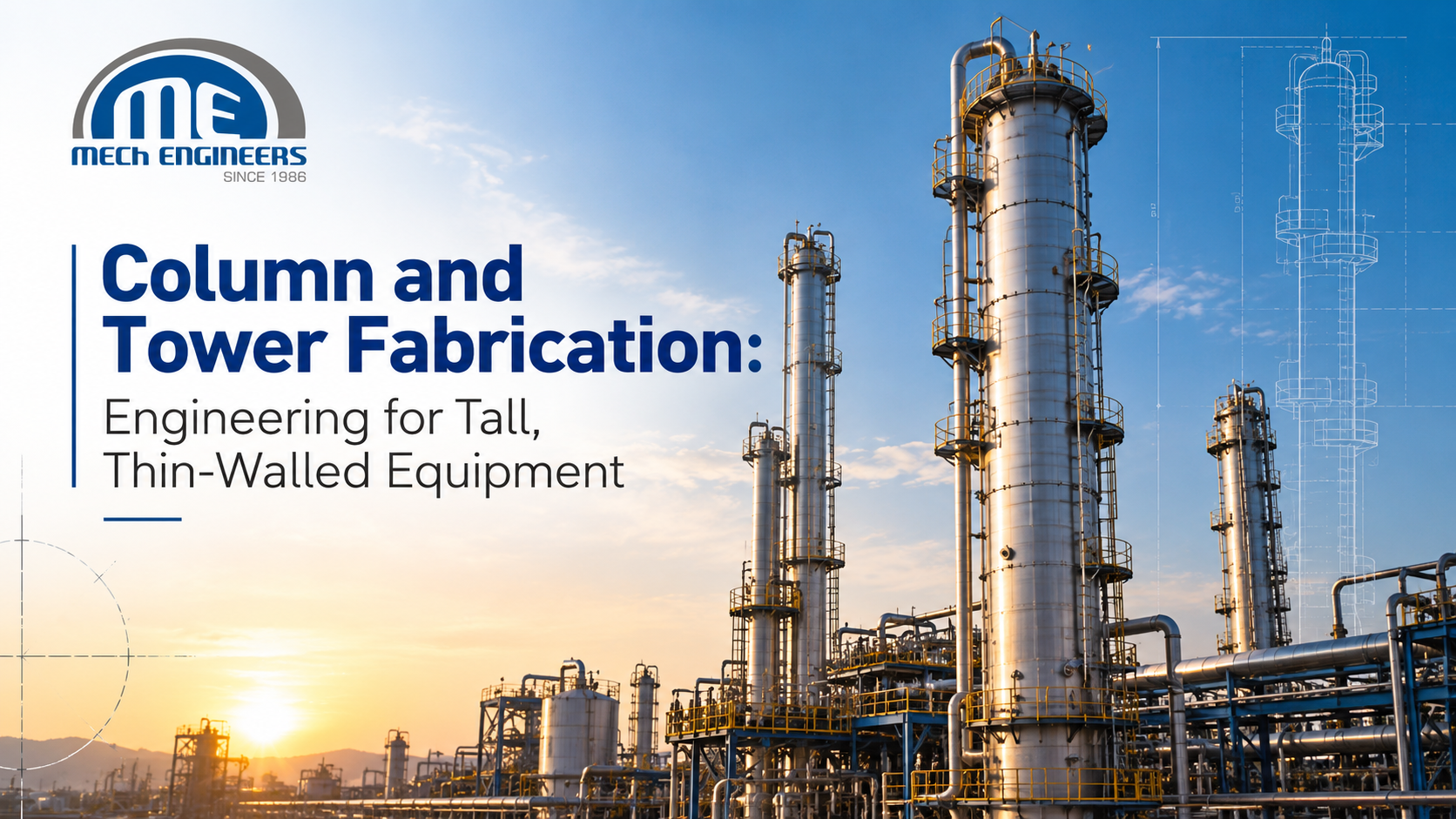
Column and Tower Fabrication: Engineering for Tall, Thin-Walled Equipment
A process column is a pressure vessel, but pressure is often not the only thing that decides how it is built. Once a shell is tall and slender, its wall is thin relative to its height and diameter, and other demands matter as much as internal pressure: wind and seismic loads, external pressure under vacuum, vibration, and the dimensional accuracy needed for trays and packing to work. Then there is the practical problem of getting a long, slender shell lifted, shipped, and erected without damaging it.
This article walks through those issues in the order a fabrication and design review would raise them. It is written for process engineers, EPC contractors, consultants, and procurement teams who are specifying or comparing columns and towers. It describes general engineering considerations. It is not a design method, and the final design of any column needs review by a qualified engineer against the project data and the governing code.
Why tall, thin-walled columns need their own review
Columns and towers cover a range of duties, including distillation, absorption, stripping, extraction, reaction, and scrubbing. MECh Engineers lists columns and towers among its static process equipment and groups these duty types together on its insights page.
What the duties share is geometry. A long cylinder behaves differently from a short one in three ways that matter for specification:
- Loads other than pressure. Wind, seismic, and weight loads act on the whole height, and the base carries all of them.
- Stability. A long shell under external pressure is easier to buckle than a short one with the same wall thickness.
- Dynamic behaviour. Slender structures can respond to wind in ways a stiff, squat vessel does not.
The sections below take each in turn, then move to fabrication tolerances, testing, lifting and procurement.
Design loads beyond internal pressure
ASME Section VIII, Division 1, paragraph UG-22 lists the loadings a designer must consider. Besides internal and external pressure, the list includes the weight of the vessel and its contents under operating and test conditions, attached equipment and supports, wind, snow and seismic reactions, cyclic and dynamic reactions, temperature gradients and differential thermal expansion (UG-22 checklist, 2025 edition). For a column, wind, seismic and weight loads usually govern the skirt, the base ring and the anchor bolts, as well as the lower shell courses.
The code requires these loadings to be considered, but the wind and seismic loads themselves usually come from a separate loading standard or the local building requirements named in the project specification. ASCE 7 is one commonly used reference, and load combinations for wind and seismic differ between the Division 1 and Division 2 approaches (discussion by a pressure vessel software vendor). The RFQ should therefore state the site wind and seismic basis and the standard to be used. It should not leave the fabricator to assume one.
The weight under test conditions deserves the same attention as operating weight. A column filled with water for a hydrostatic test can carry considerably more weight than in service, and the test position and any wind during the test belong in the design basis.
Wind-induced vibration
When wind flows past a cylinder, vortices shed alternately from its sides and push it across the wind direction. If the shedding frequency matches a natural frequency of the structure, the response can grow. The wind speed at which this happens is called the critical wind speed. Tall columns are an obvious candidate for this check (overview of column vibration).
Screening methods differ. One often-cited rule of thumb treats columns with a height-to-diameter ratio above about 15 as susceptible to wind-induced vibration (thesis on wind and seismic design of vessels). Other screening methods use weight, length and diameter together, and are implemented in design software (Bentley documentation). No single ratio replaces a project-specific assessment, so ask the designer which method was used and why.
Two practical points follow.
First, the vulnerable condition is not always the finished, insulated column. Research on wind turbine towers shows that vortex-induced vibration can be critical during installation, before the structure is complete (Wind Energy Science, 2020). A bare column shell standing on a pad, or lying ready for lifting, has a different mass and damping from the finished unit. It is reasonable to ask whether the check covers the erection stages as well as normal operation.
Second, mitigation has trade-offs. Helical strakes are one way to disturb vortex shedding, and wind tunnel work on tall slender structures has examined their effect (IIT Delhi thesis). Strakes also raise drag, which increases wind load (wind turbine tower overview), so they must be accounted for in the wind load on the shell, skirt and base. Changing mass, stiffness or damping is an alternative that has to be decided early in the design.
External pressure, vacuum and stiffening rings
If a column can see vacuum, for example during start-up, shutdown, or steam-out, the shell must resist external pressure, and the failure mode is buckling instead of rupture. Unlike internal pressure design, where shell length does not enter the thickness calculation, external pressure design depends on the unsupported length (explanation from a fabricator).
That is why long shells often use stiffening rings. Rings that qualify as effective reinforcement shorten the unsupported length, which allows a thinner shell than an unstiffened one would need (design software documentation). The trade-offs are practical:
- Rings on the outside can obstruct visual inspection and complicate insulation (overview of vacuum design).
- Rings on the inside can conflict with tray support rings, downcomers and packing.
- Either way, the ring is part of the pressure-retaining design and has to be sized, welded and inspected accordingly.
For this reason, the vacuum duty should be stated explicitly in the enquiry, including whether full vacuum is a credible case.
Materials and corrosion
Material choice depends on the process chemistry, temperature, and damage mechanisms, and nothing in the geometry changes that. API RP 571 is a widely used catalogue of damage mechanisms for refining and petrochemical equipment (overview). MECh Engineers states that it works with Hastelloy®, titanium, Inconel®, duplex and super duplex steels. Whether a solid alloy, a clad plate, or a lined construction suits a given column is a decision to make from the stream composition, not from the alloy name.
Fabricating slender shells to suit the internals
Column performance depends on trays and packing that sit inside the shell, so shell accuracy is a process issue as well as a structural one. Installation problems with internals are often traced to imprecise manufacture of the shell or the attachments, and the sequence of checks should begin in the fabrication shop: roundness, location of support rings, and levelness of rings and clips.
Three points come up repeatedly in practice:
- Roundness. A shell that is out of round beyond what the internals allow makes installation difficult, and out-of-roundness tends to appear around manways and nozzles.
- Support ring levelness. For trays, an unlevel support ring changes the liquid height on the tray, which affects performance. A case study from a column with a 4 m diameter found ring tolerances that were detected only after trays were installed and had to be corrected. For packed columns, ring levelness is less critical because the top of the bed can be levelled, so normal construction tolerances may be acceptable.
- Fit between internals and shell. Cartridge tray bundles that do not match the shell can jam during insertion, forcing in-situ modifications.
A common source of dispute is the split of responsibility. In many projects the column fabricator is responsible for the shell and its body flange, while the tray manufacturer is responsible for the trays. Agree in writing who sets the tolerances, who checks them, and whether the shell and the internals are inspected jointly before installation. MECh Engineers lists internal support structures and platforms, walkways and ladders among its products.
Welding, examination and testing
Welding procedures and welder performance for code construction are qualified under ASME Section IX. MECh Engineers states that it holds ASME U and U2 stamps; the choice between Division 1 and Division 2 for a column is a design-basis decision to be settled in the specification. The extent of examination and the pressure test method come from the governing code, the design, and the contract, so ask for the inspection and test plan at the quotation stage.
For tall equipment, the test arrangement has its own questions: whether the column is tested vertically or horizontally, how it is supported during test, and what the filled weight does to temporary supports and foundations.
Lifting, shipping and erection
A slender shell is vulnerable when it is moved. Lifting lugs or trunnions, and a tailing lug at the base, are usually part of the vessel design, and their location and strength are checked as part of a rigging study for the intended lift.
Three decisions are worth making early:
- Whole or sectional. MECh Engineers states fabrication capacity for single pieces up to 57 m in length, up to 7.8 m in diameter and up to 252 metric tons top-lifting weight. Those are shop capabilities. Whether a particular column can ship in one piece depends on the route, the port, the transport equipment and the site, and a column may need to be split into sections for shipping and joined by field girth welds.
- Field welding. If sections are joined on site, the field weld procedures, examination and any heat treatment need to be agreed in advance. MECh states that its services include installation and commissioning supervision, including welding for large or oversized equipment within its scope.
- Handling loads. Handling stresses and the possibility of ovalisation during lifting and transport belong in the design review, particularly for thin shells and for shells that will receive close-fitting internals.
Applicable code and jurisdiction
The design code is a specification and jurisdiction decision. ASME Section VIII, Division 1 covers vessels operating at pressures above 15 psig. The Pressure Equipment Directive 2014/68/EU applies to equipment with a maximum allowable pressure above 0.5 bar placed on the EU/EEA market. In the UAE, requirements are set at emirate level. Dubai Municipality’s technical guidelines cover periodic inspection of pressure vessels in use in Dubai, and do not govern construction. Confirm with the owner, the local authority and the insurer which requirements apply to design, fabrication, installation and periodic inspection, and write them into the RFQ.
How to evaluate a column and tower fabricator
Use a checklist that tests evidence.
- Comparable equipment. Ask for documented columns of similar height, diameter, material and duty, not general claims of experience.
- Certification. Ask for the certificate of authorisation and its scope, and verify it with the issuing body. MECh’s stated approvals are listed on its accreditations page.
- Design capability. Ask who performs the wind, seismic, vibration and external pressure calculations, which methods and software are used, and how the design review with the buyer works.
- Dimensional control. Ask how roundness, ring levelness and verticality are measured and recorded, and whether a joint inspection with the tray supplier is offered.
- Lifting and transport. Ask who designs the lifting attachments and how the shipping and erection plan is developed.
- Welding and examination. Ask for the welding procedure and qualification records relevant to your material, and a sample inspection and test plan.
- Documentation. Agree the data book contents before fabrication starts.
- Support on site. Ask what support is available for erection, field welding and commissioning.
What to include in a column RFQ
A complete enquiry reduces clarification rounds and the risk of an underspecified quotation.
- Duty and process data: the type of column, the process fluids and composition, and the operating and maximum pressures and temperatures
- Vacuum duty: whether vacuum or external pressure is credible, and at what level
- Geometry: inside diameter, tangent-to-tangent height, skirt height, and any diameter changes along the height
- Materials: preferences or restrictions, corrosion allowance, and any cladding or lining requirement
- Internals: tray or packing type, supplier, who is responsible for support rings and clips, and the tolerance basis
- Nozzles and attachments: nozzle schedule, external loads from piping, platforms, ladders, insulation and fireproofing
- Site loading basis: wind and seismic standards and design data, plus the soil or foundation constraints that affect the base design
- Code and jurisdiction: design code and division, other standards, site location and authority or insurer requirements
- Test and inspection: test method and position, third-party inspection and witnessing
- Logistics: route, port, transport limits, lifting capacity on site and whether sectional delivery is acceptable
- Documentation and schedule: data book contents, certificates and the delivery date
Final specification of any column needs technical review by a qualified engineer against the actual data.
Making informed decisions on column fabrication
Most problems with tall columns can be traced to something that was not stated or not agreed early: a vacuum case left out, a wind and seismic basis assumed, a tolerance that nobody owned, or a lifting and shipping plan prepared after the design was frozen. The questions that carry the most weight are the full load basis, the vacuum duty, the tolerance and responsibility split with the internals supplier, and how the column will be moved and erected.
If you are specifying a column or tower and want to discuss your requirements with MECh Engineers, you can send your process and design data through the contact page.