


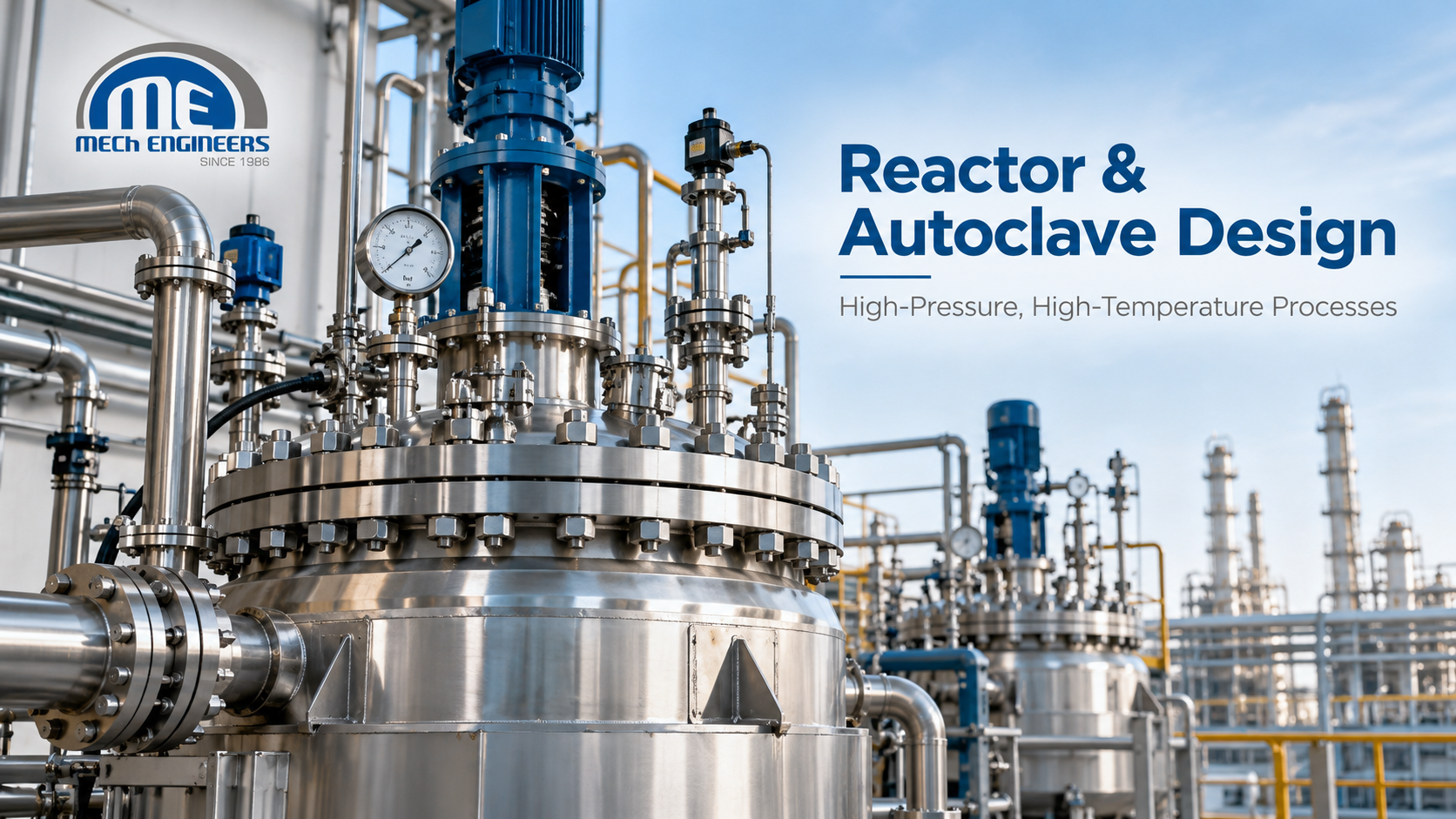
Reactor & Autoclave Design for High-Pressure, High-Temperature Processes: A Practical Engineering Guide
A reactor that works on paper can still fail in the plant. The usual causes are a gasket that creeps at temperature, an alloy that suits the product but not the impurity in the feed, or an agitator seal that was never meant for the gas being used. Most of these failures trace back to design decisions made before any metal was cut.
This guide explains how a competent reactor and autoclave manufacturer thinks through high-pressure, high-temperature (HPHT) equipment. It is written for process engineers, R&D heads and procurement teams who need to specify, compare or commission pressure equipment.
What Is the Difference Between a Reactor and an Autoclave?
In practice, the terms overlap. A pressure reactor is a vessel in which a chemical reaction takes place under controlled pressure, temperature, and mixing. An autoclave is a sealed pressure vessel, and the word is used for two quite different things:
- Process autoclaves (also called high-pressure autoclave reactors) carry out reactions such as hydrogenation, polymerisation, hydrothermal synthesis and extraction with supercritical fluids.
- Sterilisation or curing autoclaves use steam or heat under pressure to sterilise material or cure composites. These follow different design rules.
This article covers the first group: stirred or static vessels used for chemical process work, from laboratory scale to production scale.
The Design Starting Point: Define the Process Before the Vessel
Good high pressure reactor design begins with questions about the chemistry, not the geometry. A manufacturer who quotes before asking these questions is guessing.
- Design pressure and design temperature. These are not the operating values. The design pressure must sit above the maximum operating pressure with a margin that covers upsets, and the design temperature must cover the highest metal temperature the vessel can see, including during heat-up overshoot. Under pressure vessel codes, these two numbers set the wall thickness, flange rating and the allowable stress of the material.
- Media composition, including trace components. Chlorides, sulphur compounds, water, acids and hydrogen all change which materials are safe. A feed that is “mostly solvent” with a few ppm of chloride can still crack the wrong stainless steel.
- Reaction behaviour. Is the reaction exothermic? Does it generate gas? Is there a possibility of runaway? These answers drive the cooling design, relief sizing and instrumentation.
- Batch or continuous. Most autoclaves are batch or semi-batch. Continuous high-pressure systems use tubular or continuously stirred designs with different sealing and feed arrangements.
- Mixing requirement. Gas-liquid reactions, slurries with solid catalyst and viscous polymerisations each need a different agitator.
- Charging, discharging and cleaning. Opening frequency, catalyst handling and cross-contamination between campaigns affect closure type and internal finish.
Pressure Vessel Codes and Standards That Shape the Design
Pressure equipment is built to a recognised design code, and the choice of code should be agreed at the enquiry stage.
- ASME Boiler and Pressure Vessel Code, Section VIII is the most widely used code for process pressure vessels. Division 1 uses design-by-rule formulas. Division 2 permits design-by-analysis, which allows thinner walls in some cases but demands more detailed stress and fatigue evaluation.
- PED / EN 13445 applies where equipment is supplied into the European market.
- IS 2825 is the Indian standard code for unfired pressure vessels and is commonly referenced by domestic buyers.
For a buyer, the code determines who inspects the vessel, what documentation you receive, and whether the vessel can be insured, registered or exported. Ask your autoclave manufacturer in India or elsewhere to state clearly which code the quotation follows and whether third-party inspection is included.
Where cyclic operation is expected (frequent pressure or temperature swings), fatigue must be considered explicitly. A vessel that is perfectly safe for one slow pressurisation can accumulate damage over thousands of cycles at a nozzle or head junction.
Material Selection for High-Pressure, High-Temperature Service
Material choice is where a custom reactor design for chemical processes most often succeeds or fails. The question is never just “which metal is strongest” but “which metal survives this chemistry at this temperature.”
Stainless steel 316L is the common baseline for many organic and pharmaceutical processes. It is easy to fabricate and weld, but it is vulnerable to chloride stress corrosion cracking at elevated temperatures. This is a well-documented failure mode and a reason to avoid it for chloride-bearing media at high temperatures.
Duplex stainless steels (such as 2205) offer higher strength and better resistance to chloride stress corrosion cracking than 300-series grades, which can allow thinner walls. Their use has temperature limits, and they need controlled welding procedures.
Nickel alloys such as Hastelloy C-276, Inconel 625 and Monel 400 are chosen for aggressive acids, halide-containing streams and severe temperature conditions. They cost considerably more, so they are often used as a cladding or lining over a cheaper backing material rather than for the whole vessel.
Titanium performs well in oxidising and chloride environments but has restrictions with certain media, so it must be confirmed against the specific process.
Low-alloy steels (Cr-Mo grades) are used in high-temperature hydrogen service. At high temperature, hydrogen can attack carbon steel internally (high temperature hydrogen attack), and the industry uses the API 941 guidance to choose suitable materials. If your process involves hydrogenation at elevated temperature, this should be part of the material discussion.
Polymer liners and coatings (PTFE, PFA, glass) protect against corrosion but have temperature and pressure ceilings far below those of the metal itself, and PTFE can creep under sustained load. They also complicate heat transfer and inspection.
A practical rule: give your manufacturer the full composition, including contaminants and cleaning chemicals, and ask them to justify the material in writing. For sour or hydrogen-sulphide-containing service, ask whether NACE MR0175 / ISO 15156 requirements apply.
Closure and Sealing Design: The Most Failure-Prone Area
The vessel wall is rarely where problems start. Leaks begin at the closure, the agitator shaft or an instrument penetration.
Vessel closure options
- Bolted flange closure is the most common. It is robust and straightforward, but it takes time to open and close, and uniform bolt tightening matters.
- Clamp or split-ring closures speed up opening for frequent charging, with a trade-off in size limits and design complexity.
- Quick-opening or breech-lock closures are used where cycle time is critical and need careful engineering of the locking mechanism and safety interlocks.
Gasket and seal selection
Gasket material must be chosen against both temperature and chemistry. PTFE and graphite-based gaskets, spiral-wound gaskets and metal O-rings or self-energising seals each have defined operating windows. Elastomer O-rings are common at moderate conditions but run into temperature and chemical-compatibility limits quickly.
Agitator sealing
Stirred autoclaves need a way to transmit torque into a pressurised vessel. The two main routes are:
| Option | Strength | Limitation |
| Mechanical seal (single or double, often with a barrier fluid) | Suits higher torque and larger vessels | Wear parts; requires a seal support system |
| Magnetic drive coupling | No dynamic shaft seal, so lower leak risk, valuable for toxic, flammable or high-purity processes | Torque is limited by coupling strength; very viscous media may decouple it |
For hazardous or valuable media, a magnetically coupled drive is often preferred because it removes the dynamic seal as a leak path. For high-torque, high-viscosity work, a mechanically sealed drive is usually the practical choice.
Heat Transfer: Heating and Cooling Without Hot Spots
HPHT reactors usually need both heating and, for exothermic chemistry, reliable cooling.
- Electric heating (band or block heaters, heating mantles) is common in laboratory and small pilot autoclaves. It is simple, but local overheating and slow cooling are limitations.
- Jacketed vessels circulate thermal oil, steam or water around the shell. They give more uniform temperature but add a second pressure space that must itself be designed and tested.
- Half-pipe coil or limpet jackets are used where the jacket must also withstand high pressure with less wall thickness.
- Internal cooling coils add heat-removal area for strongly exothermic reactions, at the cost of cleaning difficulty and extra penetrations.
The heat-transfer design should be based on the reaction heat release rate, not just the heating requirement. Reaction calorimetry data from the client is the best input for this. If it does not exist, say so early, because undersized cooling is a common root cause of runaway events.
Agitation and Mixing
Agitator choice affects reaction rate, selectivity and heat transfer as much as pressure and temperature do.
- Gas-inducing (hollow-shaft) impellers draw headspace gas back into the liquid, which is useful in hydrogenation and oxidation where gas-liquid mass transfer controls the rate.
- Pitched-blade or turbine impellers give good general mixing and solids suspension.
- Anchor or helical impellers suit viscous products and polymerisation, where wall scraping helps heat transfer.
Baffles, impeller position and shaft design should be matched to the working volume range. A vessel used at both 40% and 80% fill needs an impeller design that works across that range.
Safety Systems and Instrumentation
Pressure equipment safety is layered. The vessel is the last line of defence, not the first.
Pressure relief. A safety relief valve or rupture disc, or both in series, protects against overpressure. Sizing must reflect the worst credible scenario, including runaway reaction or external fire where relevant, not simply normal gas generation. The relief discharge must also be routed to a safe location.
Instrumentation. Independent pressure and temperature measurement, high-limit alarms and trips, and where needed interlocks that stop heating or feed on abnormal conditions.
Operating procedures. Safe operation depends on charging limits (never overfilling beyond the design headspace), leak testing before each run with inert gas, and a defined shutdown sequence. A good manufacturer provides an operating manual, not only the hardware.
Autoclave Fabrication: From Drawing to Certified Vessel
Autoclave fabrication quality determines whether the design intent is actually achieved. The key stages are:
- Material procurement and traceability. Plates, forgings and tubes should come with mill test certificates, and the heat numbers should be traceable to the finished component.
- Forming and machining. Heads, flanges and sealing faces are machined to tight tolerances. Sealing surface finish directly affects leak-tightness.
- Welding. Qualified welding procedures and welders, appropriate to the material, are essential. For nickel alloys and duplex steels, heat input and inter-pass temperature control matter greatly.
- Non-destructive examination. Depending on the code and joint category, this includes radiography or ultrasonic testing of welds and dye-penetrant testing of surfaces.
- Heat treatment. Post-weld heat treatment is applied where the material and thickness require it.
- Hydrostatic pressure test. Under ASME Section VIII Division 1, the standard hydrotest is generally carried out at a value derived from 1.3 times the maximum allowable working pressure, adjusted by the stress ratio. The test pressure and procedure must follow the applicable code edition.
- Surface finishing and cleaning. Internal polishing, passivation of stainless steel, and cleaning for oxygen or high-purity service where required.
- Documentation. Design calculations, drawings, material certificates, weld maps, NDE reports, test certificates and, where applicable, third-party inspection sign-off.
Buyers should ask to see sample documentation packages from a previous job (with confidential details removed). The completeness of that package is a strong indicator of a manufacturer’s quality system.
How to Evaluate a Reactor and Autoclave Manufacturer
Whether you are comparing vendors in India or abroad, these checks give a more reliable picture than a brochure:
- Do they ask detailed process questions before quoting? A serious manufacturer will want composition, pressure and temperature ranges, cycle frequency and hazards.
- Can they explain their material choice? The reasoning matters more than the grade.
- Which design code and inspection route do they follow? Ask for it in writing.
- Do they have in-house machining, welding and testing capability? Outsourcing is not automatically bad, but you need to know who is responsible for quality at each step.
- Can they provide references from similar applications? Hydrogenation, supercritical processing and polymerisation each need specific experience.
- What after-sales support exists? Seal kits, spares, recalibration, re-certification and periodic inspection support matter over the vessel’s life.
- Are they comfortable with customisation? Many processes do not fit a catalogue vessel, and a manufacturer offering custom reactor design for chemical process needs engineers who can adapt nozzles, internals, jacketing and instrumentation without compromising code compliance.
Choosing an Autoclave Manufacturer in India: Practical Considerations
India has a long-established base of pressure vessel and process equipment fabrication serving pharmaceuticals, agrochemicals, specialty chemicals and dyes, with large chemical clusters in states such as Gujarat and Maharashtra. For buyers, this offers several practical advantages: shorter communication loops, easier factory visits and witness testing, and faster spares support compared with importing.
When shortlisting an autoclave manufacturer in India, a few points are worth checking specifically:
- Whether the vessel will be built and certified to ASME, IS 2825 or another code that suits your regulatory and customer requirements.
- Whether the quoted materials include proper mill certification, particularly for nickel alloys, which are costly and where substitution is a real risk.
- Whether the manufacturer will support a factory acceptance test and allow your inspector or a third-party agency to witness the hydrotest.
- Whether they have experience with your industry’s documentation expectations, such as those in regulated pharmaceutical manufacturing.
Common Design Mistakes to Avoid
Specifying by pressure and volume only. Two vessels with identical ratings can behave very differently with different media and mixing needs.
Ignoring heat-up and cool-down transients. Thermal stress at thick sections and nozzle junctions is a real concern for cycled equipment.
Choosing material on cost alone. A cheaper grade that corrodes or cracks costs far more in downtime and replacement than the saving at purchase.
Underestimating relief requirements. Relief devices sized for normal operation may be inadequate for a runaway case.
Skipping scale-up thinking. Results from a laboratory autoclave do not transfer automatically to production size. Heat removal, mixing time and gas-liquid transfer all change with scale, and this should be discussed with the manufacturer if a pilot or production vessel is the next step.
Final Thoughts
Reliable HPHT equipment comes from a chain of sound decisions: a clear process definition, the right code, a material proven for your chemistry, a closure and seal system suited to your duty, adequate heat transfer, and fabrication with documented quality. A manufacturer who treats each of these as an engineering question rather than a catalogue selection is far more likely to deliver equipment that runs safely for years.
If you are planning a new reactor or autoclave, start by writing down your full process conditions, including the contaminants and the worst-case upset, and bring that to your manufacturer’s design team. The quality of the conversation that follows is usually the best predictor of the quality of the vessel.